Daily Fans Fact: one verified fact a day
A small Instagram channel built as an exercise. Every morning a server publishes a fact, a photographic card and a Reel, with nobody at the keyboard. The machine runs on its own because a written method and a human decision sit behind every post.
The exercise
Every day the channel publishes one fact about a person from film, fashion, science, literature, art, music or sport. Each post is a 4:5 photographic card made with AI, with the name and the fact set on the image. It comes with a caption and a 29-second Reel. The seven categories turn in a fixed cycle, and so does a second one, of three: a young name, a veteran, someone no longer alive. Three and seven share no divisor, so over 21 cards every category meets all three.
From the first day there was one rule, and every other rule grew out of it: the fact has to be verified, and the picture can never contradict it.
That sounds simple. It isn't. An image model doesn't know what is true, only what is likely. A fact is the way things actually were. The whole project lives in the distance between those two, and in the method that keeps it closed.
There is a second constraint, which shaped the look of the channel: no people. Almost no frame shows a person. The card shows the place and the object that carry the fact: the boot in the pot, the empty chair, the cardboard prototype on a workshop floor. The face of the person in the fact never appears, not even blurred or turned away: when people are allowed at all, the framing leaves the face out.
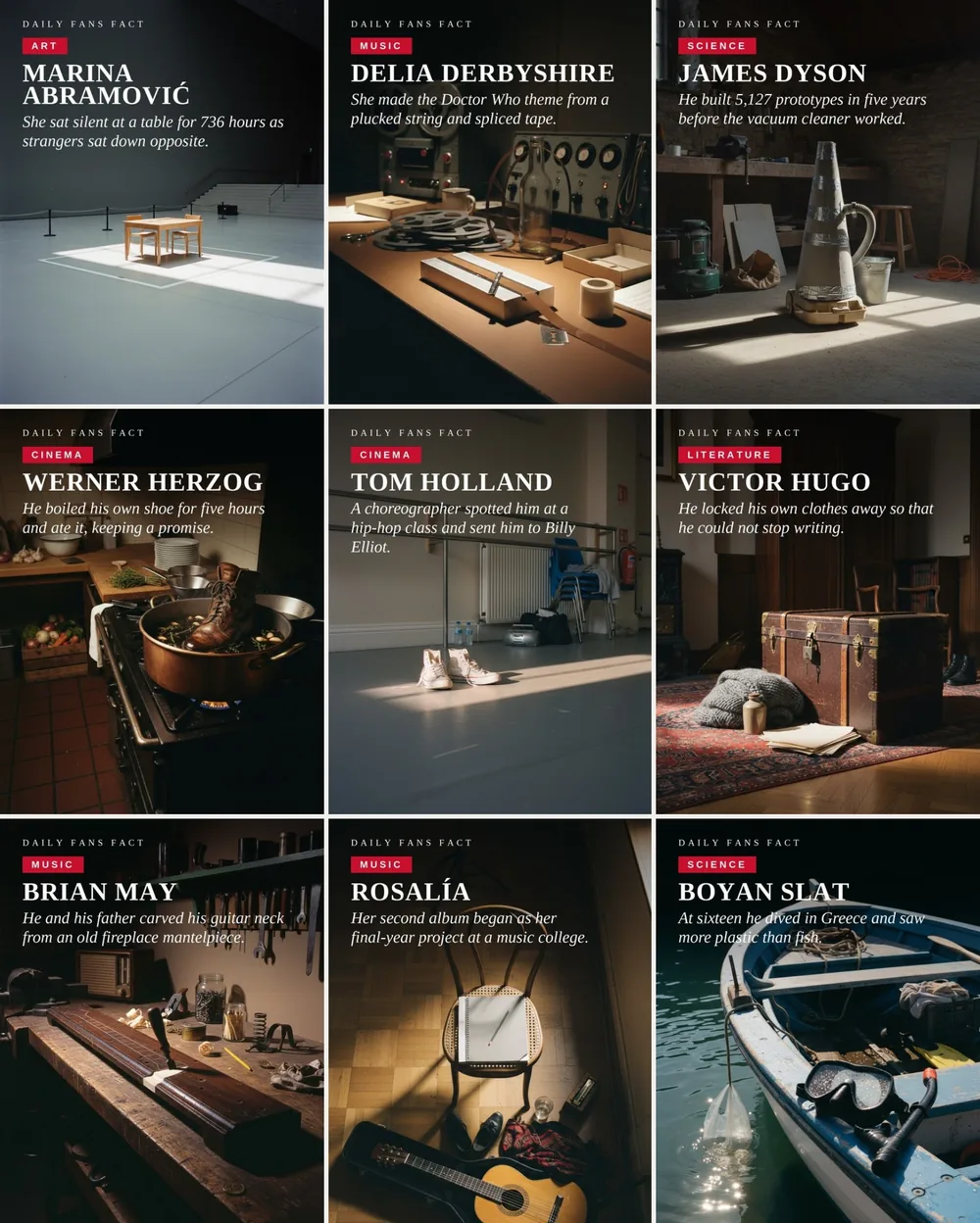
Nine published cards. Zero people, one object per fact, and the top of every frame kept dark for the words.
The method is a document
The first thing worth showing isn't code. It's a text file.
Every session, before anything else, the AI reads the runbook: the full procedure for making a card, from choosing the name to archiving the published post. On 7 October 2026 it reached revision 101 and 17,674 words. It's written in Italian, the language its author, Filippo Giani, thinks in. The channel speaks English.
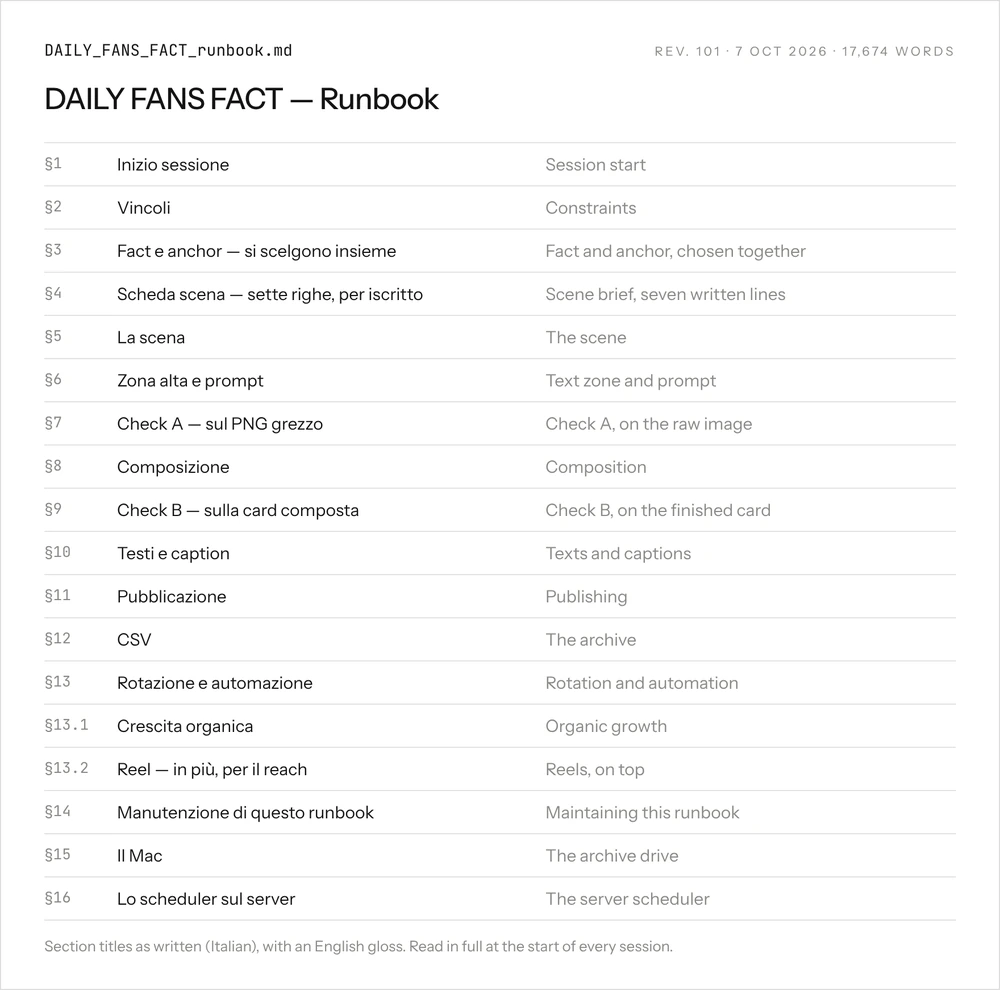
The runbook's sixteen sections, as written, with an English gloss. The AI reads it in full at the start of every session.
Three habits keep the document alive instead of decorative:
- A rule agreed is written immediately.Not at the end of the session. A rule that exists only in conversation doesn't exist for the next generation.
- A correction is a rule first, a card second.When something goes wrong, the first question is what kind of error it was and what should change in general. Fixing the single card comes after.
- One lesson, one write.The rule goes into the runbook, in its place in the process. The card archive gets one short line naming the cause. No diaries, no history of revisions.
This is the part that makes the system self-running. The AI session that checks Wednesday's post has no memory of the conversation on Sunday. It has the document. If a decision isn't in the document, it was never made.
Decide before generating
An image costs a few seconds and a credit. The wrong image costs the check, the rewrite, the second attempt, and sometimes a post that has to come down. So the work happens before the first generation.
The fact. Facts are checked across several sources. If they agree, the caption carries no source. If there's only one origin, the caption says so: Source: outlet, year. Anything unverifiable or gossipy is dropped. Details on which sources disagree are left out. The fact should make the person look interesting, never smaller. No illness, no current tragedy.
The anchor. Between two valid facts, the one with a place and an object wins. The object, the anchor, is found in a fixed order: gesture, then place, then object. A small generic object isn't strengthened by adding more objects; you go up to the gesture or the place. Small round objects are banned as anchors. A ball says "sport". It doesn't say that athlete.
The scene brief. Before any prompt, every scene gets seven written lines. Among them: the place, inventoried with six to twelve things it really had in that year; who is in frame (normally nobody); what makes the fact readable without reading; where the camera is and what stays out of shot; the era and the palette, named. If a line is empty, the prompt isn't written.
The variety check. A feed is seen three posts per row, so a card that is perfect on its own can be wrong next to yesterday's. Before each scene, the viewpoint, the side the light comes from and the kind of place are checked against the last three published cards in the archive. Two "workroom with a table" scenes in a row don't pass, even in different cities and decades. Filippo's note on this one was short (translated from Italian): "The table must be RARE." Since then it has a quota: at most two cards in seven.
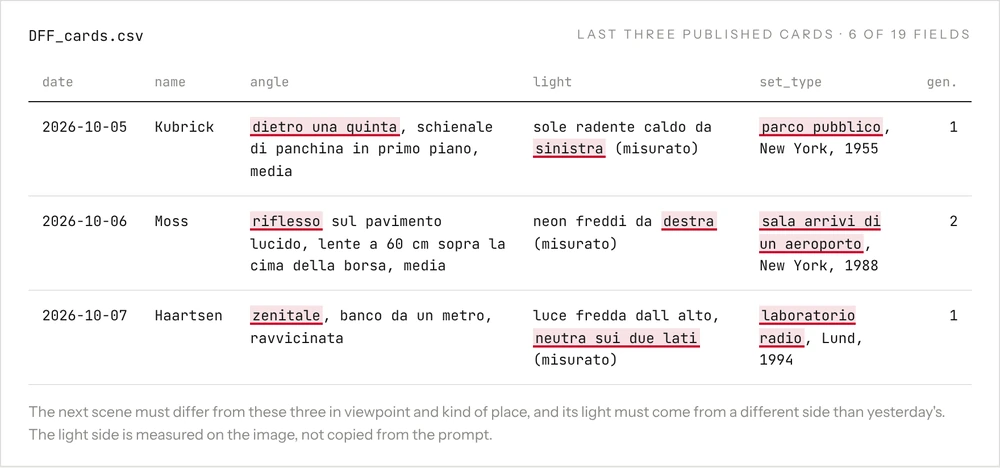
The archive is the only source of truth about what has been published. Viewpoint, light side and kind of place are compared before every new scene.
Writing for a machine that draws
A good prompt for this channel is long and boring, on purpose. The one behind the James Dyson card runs to 440 words, and it worked at the first generation.
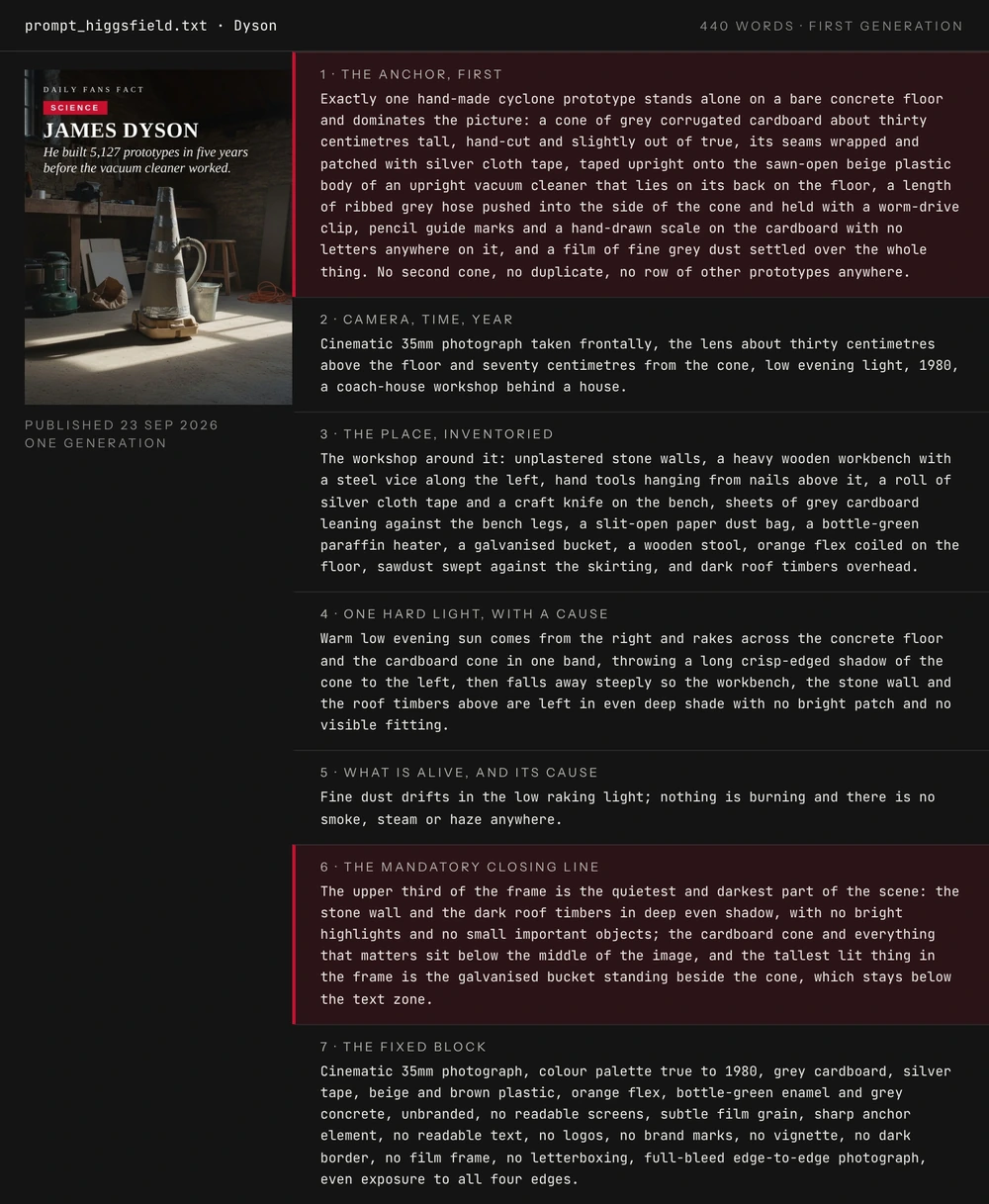
Anatomy of a prompt that worked the first time. The anchor comes first; the closing line protects the text.
The order is fixed, and each part exists because of a failure:
- The anchor first, in detail. The model needs the centre of the image at the start, not in the middle. The cards that cost the most generations all had the inventory of the place before the object.
- Camera, time, year, described as what you see. Centimetres stay in the brief: opening with numbers gave cold, shop-window pictures.
- The place, inventoried. Era isn't a label. "A 1960s living room" produces a living room from today. Walnut panelling, a barkcloth curtain and a low tweed sofa on tapered legs produce the 1960s.
- One hard light, with a direction and a cause. Soft, flat light is what makes AI images look like renders.
- What's alive, and why. Dust in a beam of light, wind on fabric. And the negative, stated: if nothing is burning, there is no smoke.
- The mandatory closing line. The top 45% of the card belongs to the text, so it has to be the darkest, quietest part of the scene. The prompt must name the tallest lit object in the frame, and that object must sit below the text. If the tallest thing would be the object that carries the fact, the scene is wrong and isn't generated.
- A fixed block, the same every time: no readable text, no logos, no vignette, no dark border.
Some limits of the model became rules of writing. It can draw exactly one of something. It can't count beyond that. It can't draw a process with a direction in time, like paper feeding into a typewriter or film running through a projector. So it gets the state before or after. It turns negations about objects into objects: write "no window" and a window appears. And it reads "lies on the table" loosely: a fan of umbrella ribs asked to lie flat came out standing like a bunch of flowers. Now anything that normally stands gets a ceiling in centimetres.
Every rule has a failure behind it
These are four of them, side by side with the card that was published instead.
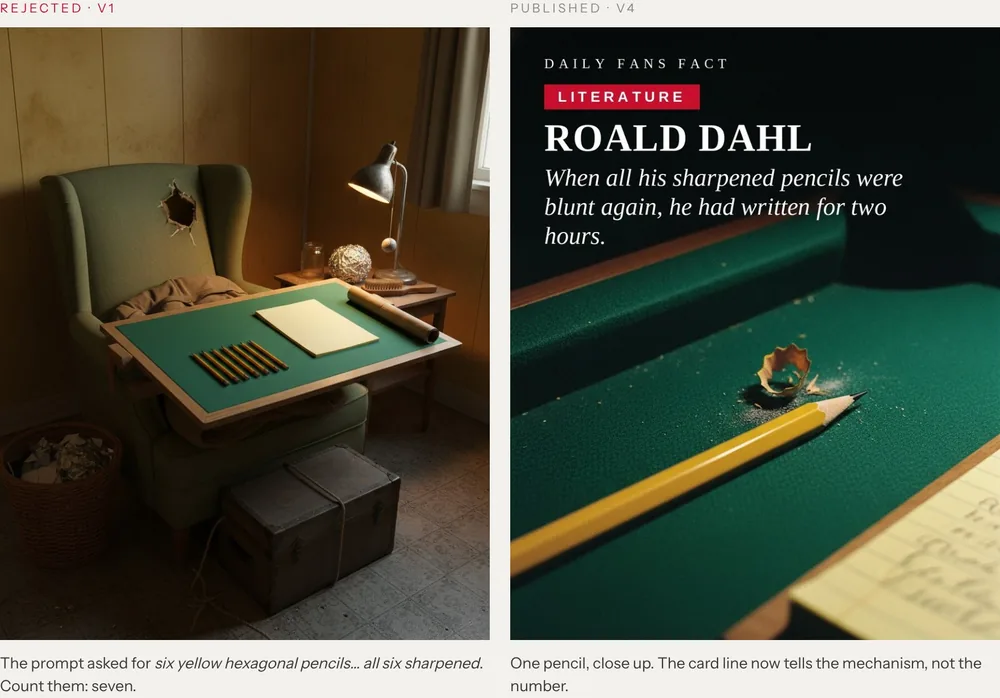
Roald Dahl. Asked for six pencils, the model drew seven. A number greater than one doesn't get published if the reader can count the objects.
The Dahl card taught the hardest rule in the series. An early version went out with seven pencils under a caption that said six, and it had to be redone. Moving the number from the card to the caption doesn't hide it: the reader counts. Now the count is taken out of the image entirely. One object, or a bundle nobody can count. The card line tells the mechanism instead: When all his sharpened pencils were blunt again, he had written for two hours.
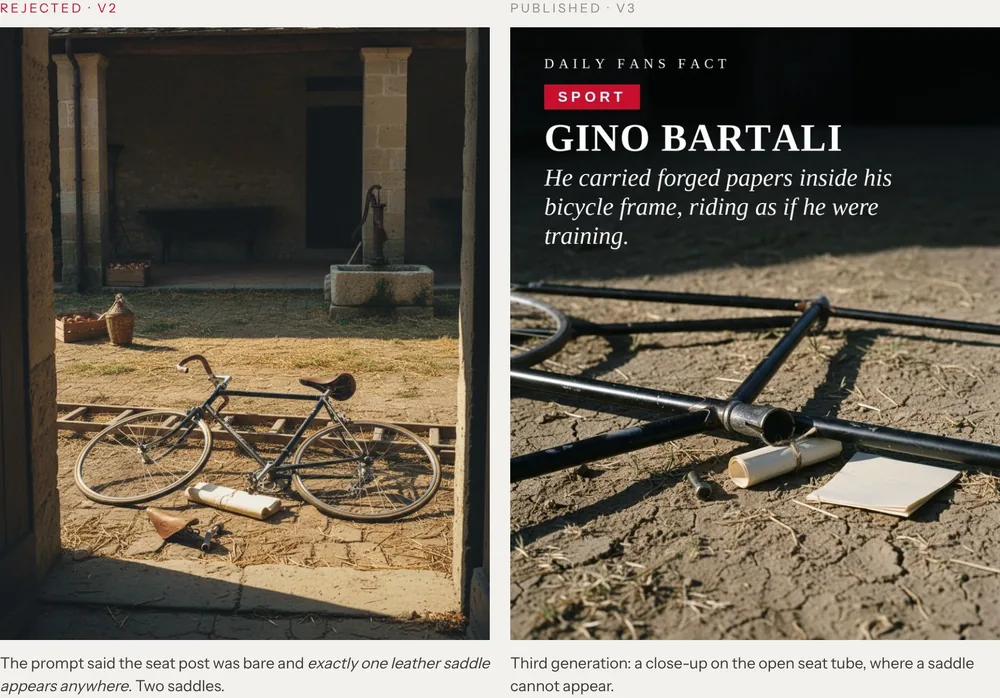
Gino Bartali. The prompt asked for a bare seat post and exactly one saddle. The model drew the bicycle complete, and added the saddle on the ground anyway.
"Exactly one" protects against duplicates, not against a part that has been removed. When a fact says something was taken out of a machine, the model draws the machine whole and adds a second copy beside it. After two generations like this, the rule kicked in: the third generation is an essential close-up of the same anchor. Close up on the open seat tube, a saddle has nowhere to appear.
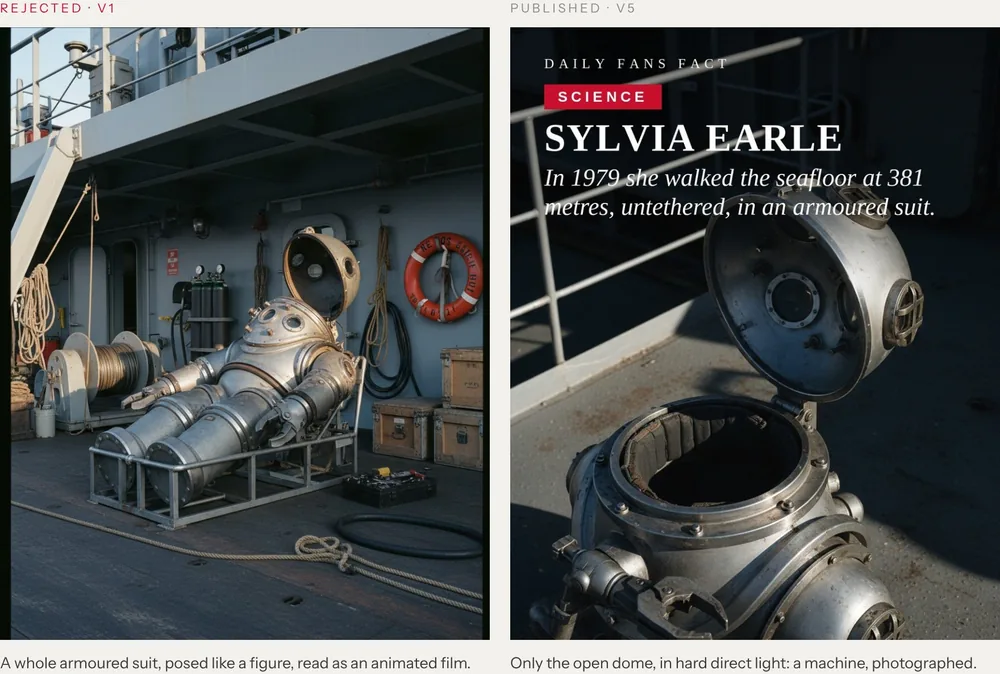
Sylvia Earle. A whole diving suit in a posed, figure-like stance read as an animated film. The open dome in hard light reads as a machine.
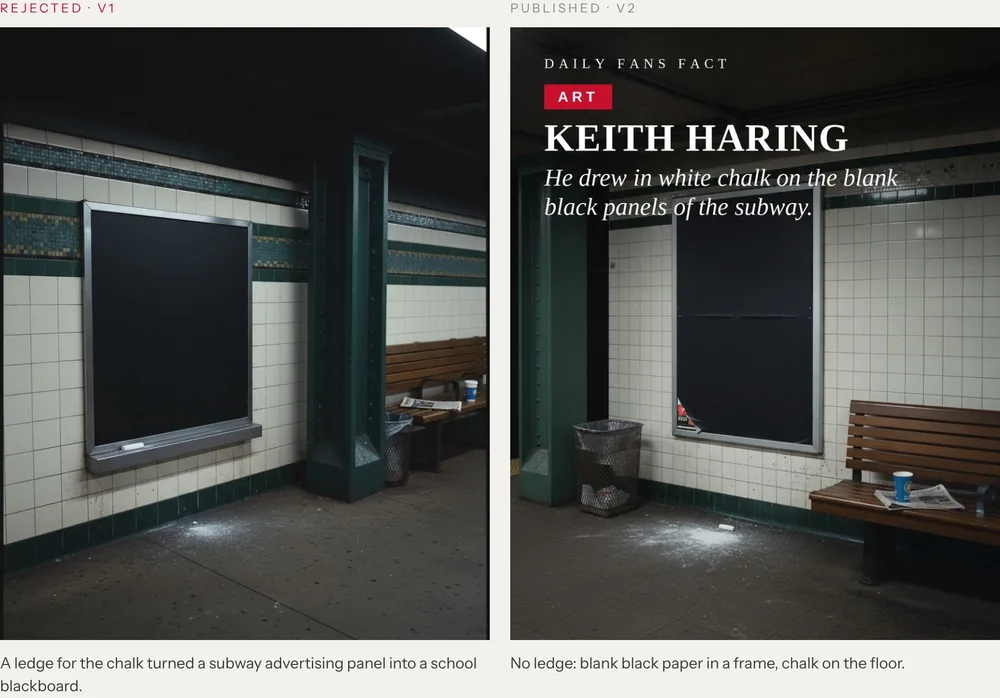
Keith Haring. A ledge for the chalk turned a subway advertising panel into a school blackboard.
The Haring case is the subtle one. The rejected image was a good photograph, and no checklist line would have flagged it. One small invented support changed what the picture is of. The test that came out of it: ask what object the scene would be if someone looked at it without the text.
None of these were bad pictures. They were pictures that said something the text didn't. That's the only failure that matters on this channel.
Checks, written down
Two checklists run on every generation, and both are written out, line by line, with a verdict on each line. Check A has nine points and runs on the raw image, before anything is composed. Check B has three and runs on the finished card. A line that isn't written wasn't done. This rule came from two black edges that got within one step of publishing, "checked" in the head while the attention was on something else.
Check A starts with the two defects a single image can't show: viewpoint and kind of place, against the last three cards. Lettering in the scene is zoomed in, because the model likes to invent alphabets. Objects are counted, one by one.
Some of this is code. The scripts are small and specific, and they print the rule along with the result.
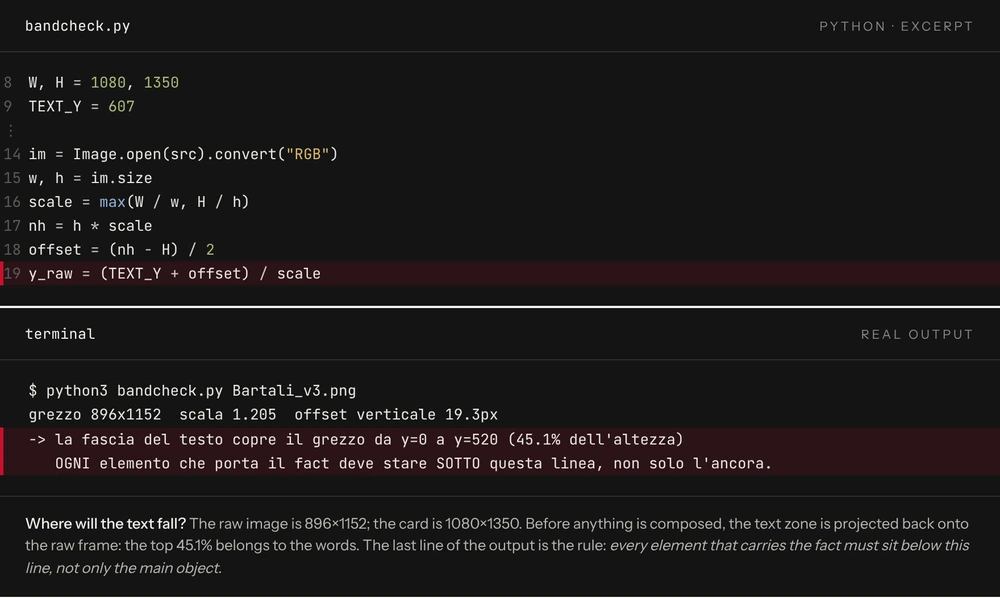
Before composing, the text zone is projected onto the raw frame. Everything that carries the fact must sit below the line.
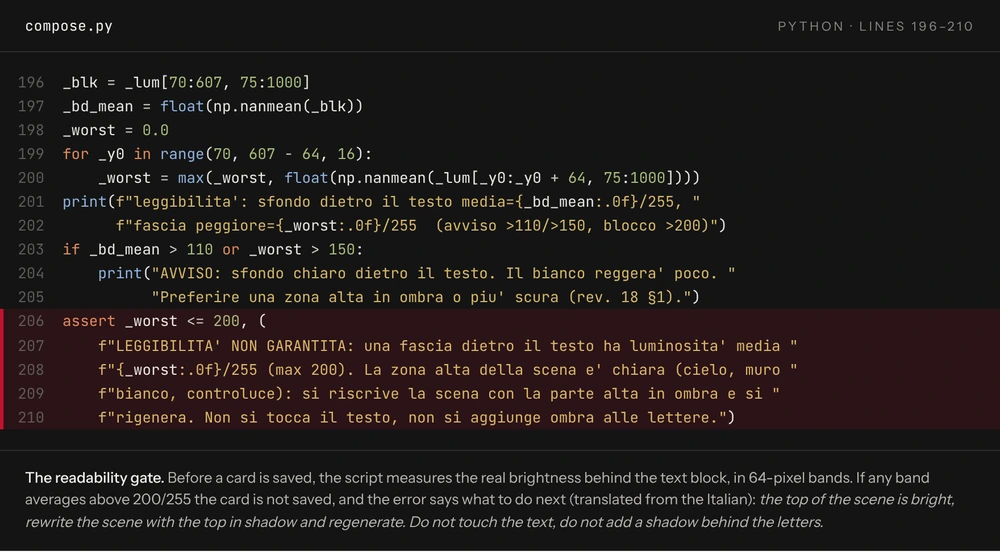
The composer refuses to save a card if the background behind the words is too bright. The error message is an editorial rule: change the scene, never the text.
The composer is never rewritten from memory; its fonts, gradient and thresholds are fixed. Run on the raw image of the Dahl card with the same three lines of text, it rebuilds the published card identical to the pixel. When a card fails the readability gate, the fix is never a shadow behind the letters. The fix is a new scene.
But the most useful lesson about the scripts came from one that was wrong.
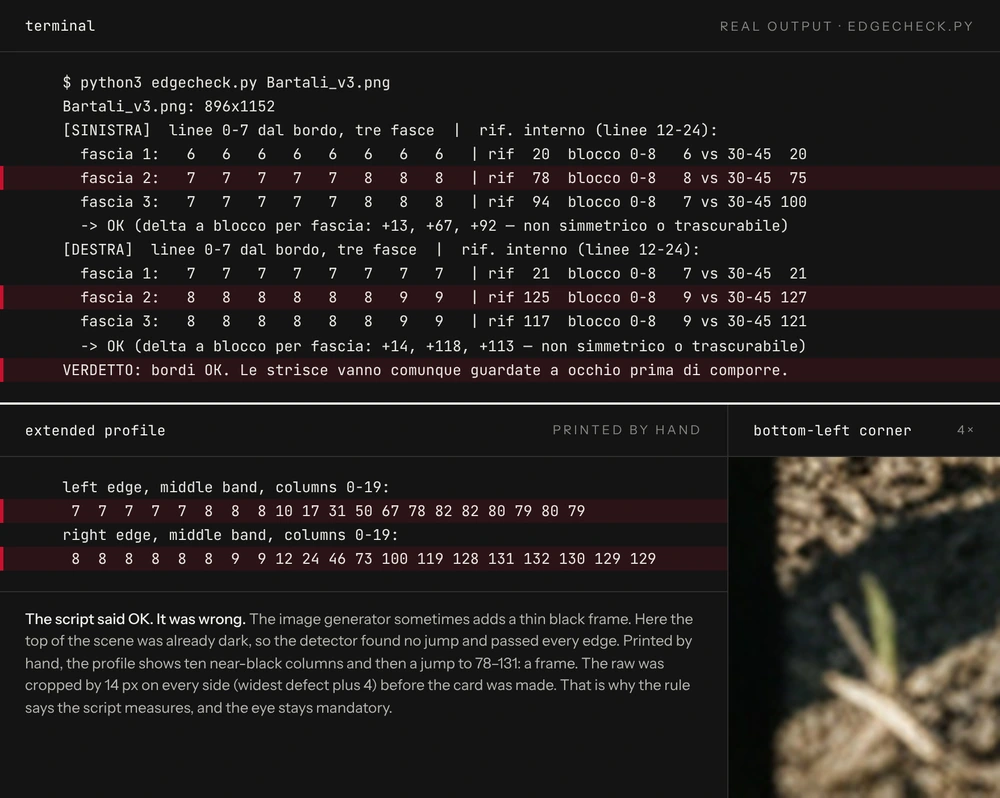
The edge detector passed this image. A profile printed by hand found a black frame about ten pixels wide. The script measures; the eye stays mandatory.
Image generators sometimes add a thin black frame around the picture. A script looks for it on all four edges. On the Bartali close-up it said OK, because the top of the scene was already dark and it found no jump to measure. The extended profile, printed by hand as the rule requires, showed about ten near-black columns and then a jump. The image was cropped by 14 pixels on every side (the widest defect plus four, so the centre doesn't move) before the card was made.
That rule now reads: the script is the measurement; the eye remains mandatory. Every check in the system works this way. Code catches what it can measure, consistently, and a written human verdict sits on top.
Who decides
Everything above could be read as a recipe for removing the person. It's the opposite. The method exists so that the person's decisions hold even when the person isn't there.
The approval is the boundary. On Sunday, Filippo sees the seven cards and approves them. From that moment the list is locked. The approved scene is executed exactly as approved, and every problem is solved inside that scene. The fallback chain has no "change the fact" and no "change the name". Without him, the approved list runs, and that's all.
Stop means stop. After "stop", "don't generate" or "let's decide first", there are no generations and no publishing until he approves a written proposal. An earlier instruction isn't an approval: "fix these three defects" authorises the next generation, not the ones after it.
Judgement beats the number, both ways. If he says a card works, it works, even when a measurement complains. If he says it doesn't read, it doesn't read, even when every check passed. A frame he has accepted isn't regenerated for a small detail. The detail gets reported and he decides. A corrective regeneration puts the whole frame back in play, and more than once it produced a worse card.
An error he spots is a process failure. The card gets fixed, and so does the step upstream that let it through.
He also writes the most precise rules, often in one line. On a double tennis net drawn by the model, translated: "A double net on a tennis court has NEVER been seen. It's an error that is NOT ACCEPTABLE." That became a rule of its own. An object everyone knows is never a detail, even if the text doesn't mention it.
A server that publishes on its own
The creative work happens with a person in the room. Publishing doesn't need one.
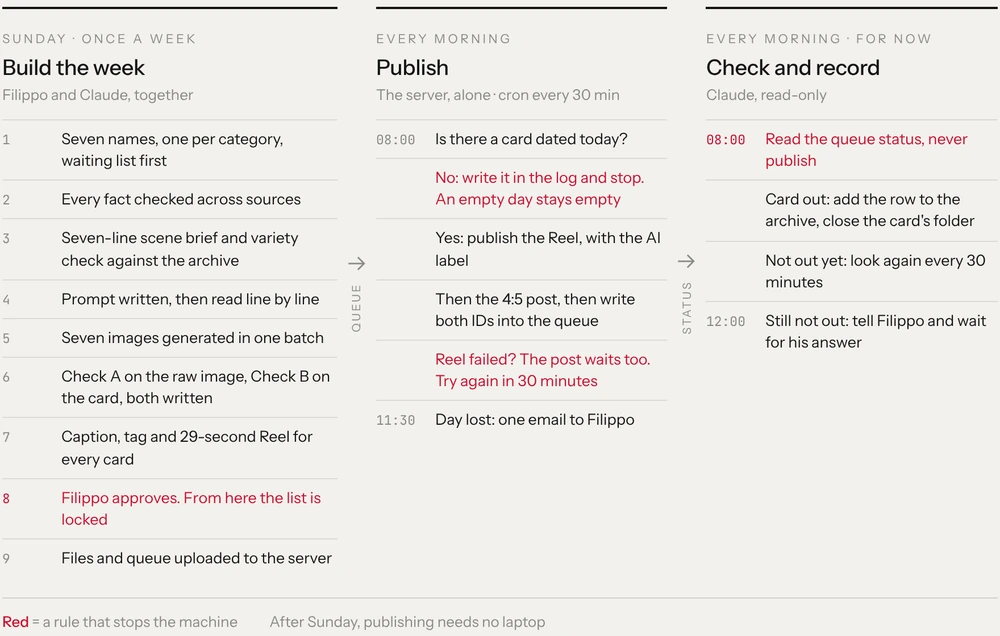
The week. Everything that needs judgement happens on Sunday; every morning a server publishes, and a read-only check records the result.
On Sunday the week is built: seven names (the waiting list first), seven verified facts, seven scene briefs and prompts, one batch of images, the written checks, captions, Reels. Filippo approves. Then the files and a queue go up to a small server in Switzerland.
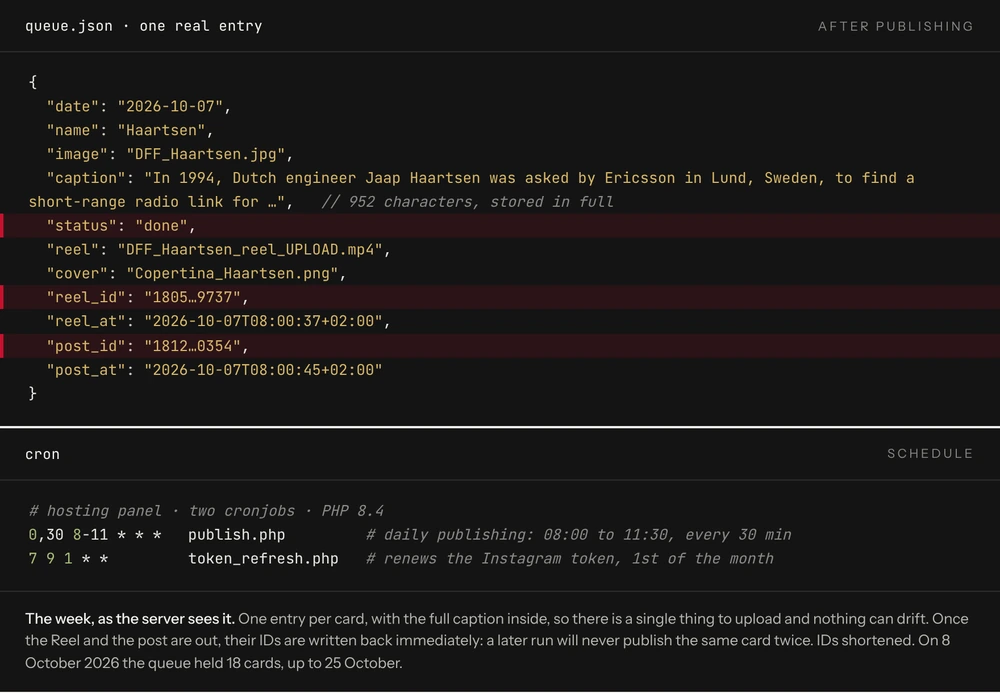
One real entry from the queue, after publishing. The caption travels inside the queue, so there is one thing to upload and nothing can drift.
From then on, two scheduled jobs do the rest. Every day, from 08:00 to 11:30, every thirty minutes, the server looks for the card dated today. If there's none, it writes that down and stops: an empty day stays empty, and nothing gets moved to fill it. If there is one, it publishes the Reel first, with Instagram's AI label switched on, waits for the platform to finish processing it, then publishes the post. Both IDs are written back into the queue right away, so a later run can never publish the same card twice. The second job renews the Instagram access token on the 1st of every month. The token lives on the server and nowhere else.
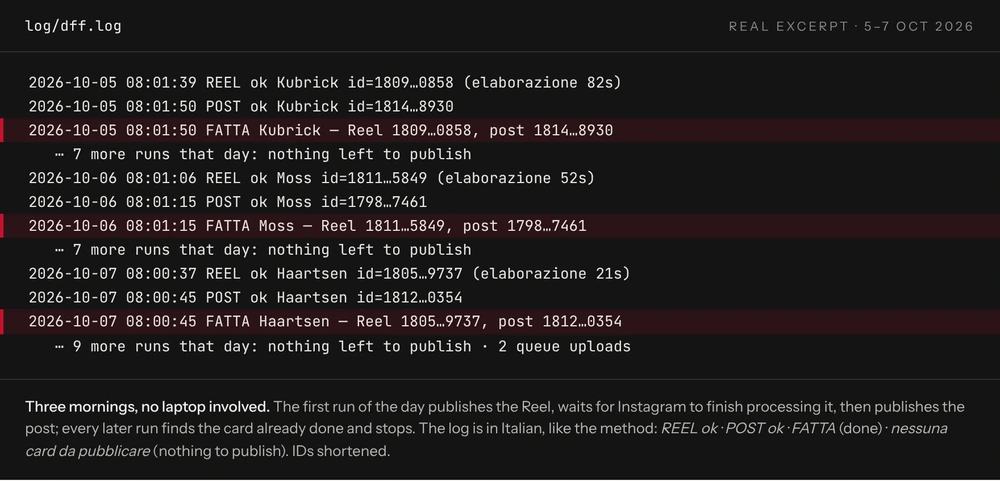
The real log of the first three mornings on the scheduler. One run publishes; every later run finds the work done.
One rule from Filippo shapes the whole publishing logic. Translated: "If you can't upload the Reel, you must NOT upload the post." On the profile grid the post and its Reel sit side by side, Reel first. A Reel published after its post lands above it and breaks the pair. So if the Reel fails, nothing goes out, and the server tries again half an hour later. Postponing the pair costs a day. Publishing the post alone costs the Reel. If the whole morning fails, one email arrives, and nobody publishes anything on their own initiative until Filippo answers.
During the first weeks a third actor watches. At 08:00, a scheduled Claude session reads the queue status, never publishes, adds the row to the card archive and closes the card's folder. If the card isn't out by noon, it messages Filippo and waits. It's a safety net with a planned end: once the server has run a full week clean, Filippo decides whether to switch it off.
The Reel
Each card also becomes a 29-second Reel, built from the same approved image and the same text. It's an addition, never a replacement. The 4:5 image is extended to 9:16, a five-second clip is generated from that image, and three text cards follow: the fact, the short biography, and the channel's sign-off.
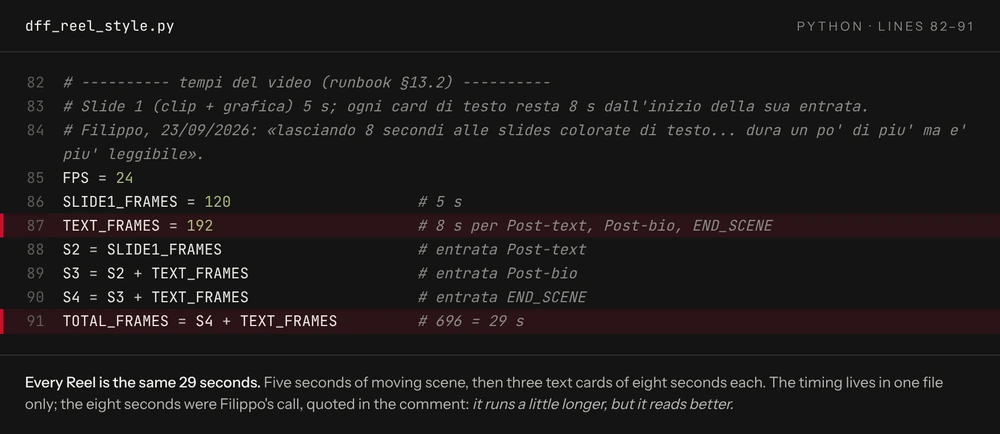
Every Reel has the same structure and timing, set in one place. The eight seconds per text card were a reading decision, not a technical one.
The clip has its own rules, learned the same way. Objects stay still in space; only the camera moves. No object ever "slides out of frame", because the model will make it fly. Nothing alive enters. The camera move changes every day and has to catch the eye. Filippo's brief: no "grandpa moves". Before editing, the anchor is measured against the objects around it at the start, middle and end of the clip. If it drifts, grows or rotates, the clip is rejected, however good it looks.
The Reels go out silent: Instagram's music library exists only in the phone app, and the point was a system that runs without a phone or a laptop.
What the numbers say
The most interesting line is the fourth. The model didn't change: one credit per image, the same model, from the first card to the last. The runbook says so explicitly: the model has never been the problem. What changed was the writing before the generation. The first 16 cards averaged 2.88 generations each and four of them worked first time. The 29 after averaged 1.41, and 18 worked first time.
The fifth line is the honest one. On 25 September, 32 posts from the first two days were taken down; only one stayed online. Many had people or hands in frame, and as a set they couldn't carry a Reel. They are coming back one by one, rebuilt without people from the same verified facts.
What it taught
- Decide before generating.A written brief for every image. The target is one generation per result, and the average shows it's realistic.
- Write the method down, and write it now.The machine that runs on Wednesday knows only what Sunday wrote.
- Code measures, people judge.Every check is half script, half written verdict. A script that says OK is a measurement, not an approval.
- The text is the fact. The picture serves it.Anything the published words claim is never a detail. Everything else is tolerance.
- Automation shouldn't depend on a laptop.Creative work with the person present; publishing from a server; never a half-published day.
Daily Fans Fact started as an exercise to find out whether daily AI content could be steady, checked and self-running. It can, as long as someone has decided what "right" means and written it down.